
When Your Toddler Hits, Bites, or Throws — And You Don't Know Whether to Cry or Run
Your toddler hitting, biting, or throwing isn't a parenting fail — it's a feeling they can't say out loud. Learn how to respond calmly (without losing it) using The CART Method™.
Bhakti
3/5/20266 min read
Picture this.
You're at the park. The sun is out. Your toddler is playing. You're almost — almost — feeling like you have this parenting thing figured out.
And then.
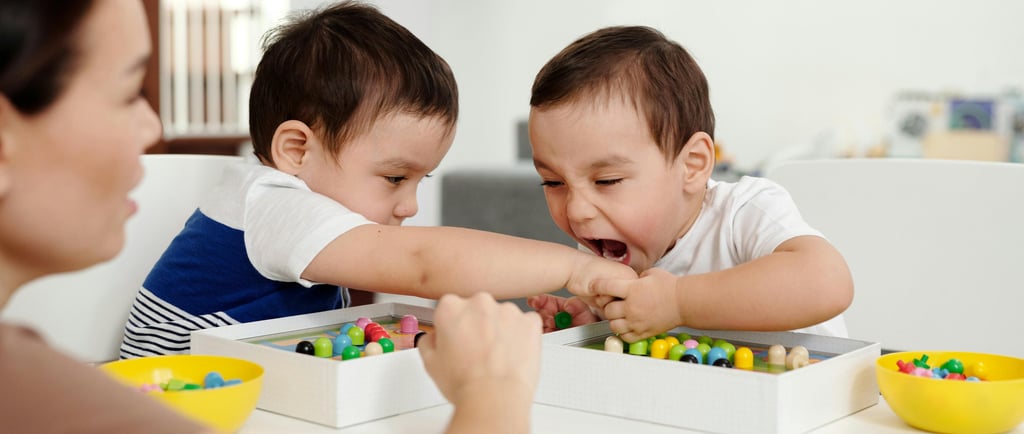
They haul off and smack another kid over a plastic shovel. Or they sink their teeth into your arm mid-cuddle. Or they launch their snack plate across the room like it personally wronged them.
Every eye turns to you.
Your face goes hot. Your stomach drops. And your brain is already doing that thing, what is wrong with my kid, what am I doing wrong, why does this keep happening, while on the outside you're trying to look like a parent who has it together.
If you've stood in that exact moment, this is for you.
You're Not Failing. You're Just Missing the Translation.
Here's the thing about toddlers between ages 1 and 4: they are walking, breathing emotional experiences with almost no way to communicate them.
The part of the brain that handles impulse control, reasoning, and emotional regulation is still years away from being functional. What is fully online is the part that feels everything.. intensely, immediately, and physically.
So when your toddler feels frustrated, overwhelmed, powerless, or overstimulated.. their body responds before their brain can do anything about it. The hit lands. The bite happens. The plate flies.
It is not calculated. It is not manipulation. It is a small person completely flooded by a feeling they cannot name, doing the only thing available to them in that moment.
They are not giving you a hard time. They are having one.
And the moment you really absorb that, not just intellectually, but in your gut, something shifts. Because it stops being about controlling the behavior and starts being about reaching the child underneath it.
But First, Let's Talk About What Happens to YOU
Because nobody talks about this part.
When your toddler hits or bites, something happens in your body too. Heart rate spikes. Jaw tightens. A wave of frustration: real, hot, totally human frustration rises up faster than you can stop it.
And if you grew up in a home where chaos was met with yelling, punishment, or shame? Your nervous system didn't learn any other way. It just learned: big feelings = big reaction. That pattern lives in you. It's not a flaw. It's just what got passed down.
So in the moment your toddler melts down, you're not only managing their emotions. You're also quietly wrestling with your own — the guilt, the embarrassment, the echo of how you were handled when you were small.
This is the part most parenting content completely skips.
Because responding calmly to a toddler who just bit you isn't just about knowing the right thing to say. It's about having enough space inside yourself to choose something different than what was chosen for you.
That space? It has to be built. Intentionally. And it starts with understanding that your calm is not the absence of reaction.. it's the most powerful parenting tool you have.
I Used to Snap. Every Single Time.
I know this from the inside.
There was a time when my toddler's meltdowns sent me straight into react mode. The hit would happen and something in me would match their energy: sharper tone, louder voice, a threat I didn't even fully mean. Every time, things escalated. Every time, I ended up feeling like the worst version of myself.
I grew up being yelled at. So yelling felt like the natural response to chaos. It was the only script I had.
What changed everything was a single reframe: my child wasn't trying to push my buttons. They were drowning. And they needed me to be the one who didn't drown with them.
That realization and everything I built around it became The CART Method™. Not a behavior management system. Not a list of steps to follow. A way of parenting that starts with connection, because connection is what actually changes things.
What "Connect First" Actually Looks Like at 7pm on a Tuesday
The instinct when a toddler hits is to immediately address the behavior. Get firm. Set the boundary. Make it clear that this is not okay.
And yes, the boundary matters. But the order matters more.
A toddler whose nervous system is flooded cannot hear you. Cannot process a consequence. Cannot learn anything you're trying to teach in that moment. Their brain is in survival mode and survival mode has exactly one job: react, not receive. And this is true not just for toddlers but for adults as well.
So before the boundary, before the correction, before any of it — you connect. You get down to their level. You bring your body calm. You make them feel like the world isn't ending, even when their face says it is.
Not because the behavior was fine. But because connection is what opens the door. It's what tells their nervous system: you're safe, I'm here, you can calm down now. And only once they can calm down can they actually hear anything you have to say.
This is the part that feels counterintuitive at first. It can feel like you're letting it go, or going soft, or rewarding the meltdown. You're not. You're just doing the thing that actually works instead of the thing that feels satisfying for about four seconds and then makes everything worse.
The Feeling Was Always the Point
Here's what hitting, biting, and throwing all have in common: they are feelings that ran out of road.
Frustration with nowhere to go becomes a hit. Overwhelm that can't be spoken becomes a bite. Powerlessness that has no other outlet becomes a flying plate.
The behavior is never the bigger thing. The feeling underneath it always is.
And when you respond to the feeling first, when you say you're really upset right now, that makes sense before you say and we don't hit something shifts. Not just in them, but in the dynamic between you.
You become the safe place. The person who gets it. The one they can fall apart in front of without being shamed for it.
That is not permissive parenting. That is the foundation of emotional intelligence, the understanding, built slowly through hundreds of small moments, that big feelings are survivable and that the people who love you will help you through them.
What This Actually Sounds Like in Real Life
Your toddler just bit you. Here's the honest version of what to do:
Take a breath first. (Yes, even when it hurts. Especially when it hurts. Your regulated nervous system is the whole game here.)
Get low. Get quiet. "Hey. I'm right here."
Then: "You're really upset. Something felt really big just now."
Then with calm and firm voice, without any lecture: "Biting/Hitting hurts. I won't let that happen."
Stay close. Hold their hands if you must. Let them come back to calm. Don't fill the silence with a speech.
And after, not during, after they've settled: "When something feels that big, you can come to me. I want to help you." Or an example for when they are overwhelmed and you are not around you can teach them alternate ways to let their energy out, like stomping.
That's it. No spiral. No shame. No power struggle that leaves you both completely wrecked and no closer to anything changing.
Just you, staying in the room, being the calm they can't yet create for themselves. That's the whole thing. And it works not because it's magic, but because it's what a developing nervous system actually needs to learn how to regulate.
For the Mom Who Already Lost It Today
If you're reading this after a moment where you snapped yelled, threatened, completely came undone, this part is for you.
You are not ruining your child.
One hard moment does not erase the love, the effort, the thousand other times you showed up. And here's something worth knowing: going back to your toddler and saying "Mommy got really upset and I shouldn't have yelled. I love you" that repair matters. That moment teaches them something too. That relationships survive hard moments. That people own their mistakes. That love doesn't disappear when things get messy.
That's not failure. That's the cycle breaking, quietly, one moment at a time.
You're not starting over. You're just getting better at this. And so are they.
The Bottom Line
Your toddler hitting, biting, and throwing is not a verdict on your parenting. It's a feeling, looking for a way out of a body that doesn't yet have the words.
Your job isn't to eliminate the chaos. It's to stay in it with them, calm enough, present enough, connected enough until they can find their own way through.
That's what The CART Method™ is built on. Connect first, correct later. Not because it's easy. Because it's the thing that actually works.
Ready to stop white-knuckling through the hard moments? The CART Method gives you the full framework, and nervous-system tools to start using today, because you deserve to feel like you know what you're doing, even on the hard days.