
The CART Method™
Connect | Accept | Regulate | Thrive
A simple framework to help you survive tantrums, build connection, and raise emotionally intelligent kids, without losing your sanity.
What is The CART Method?
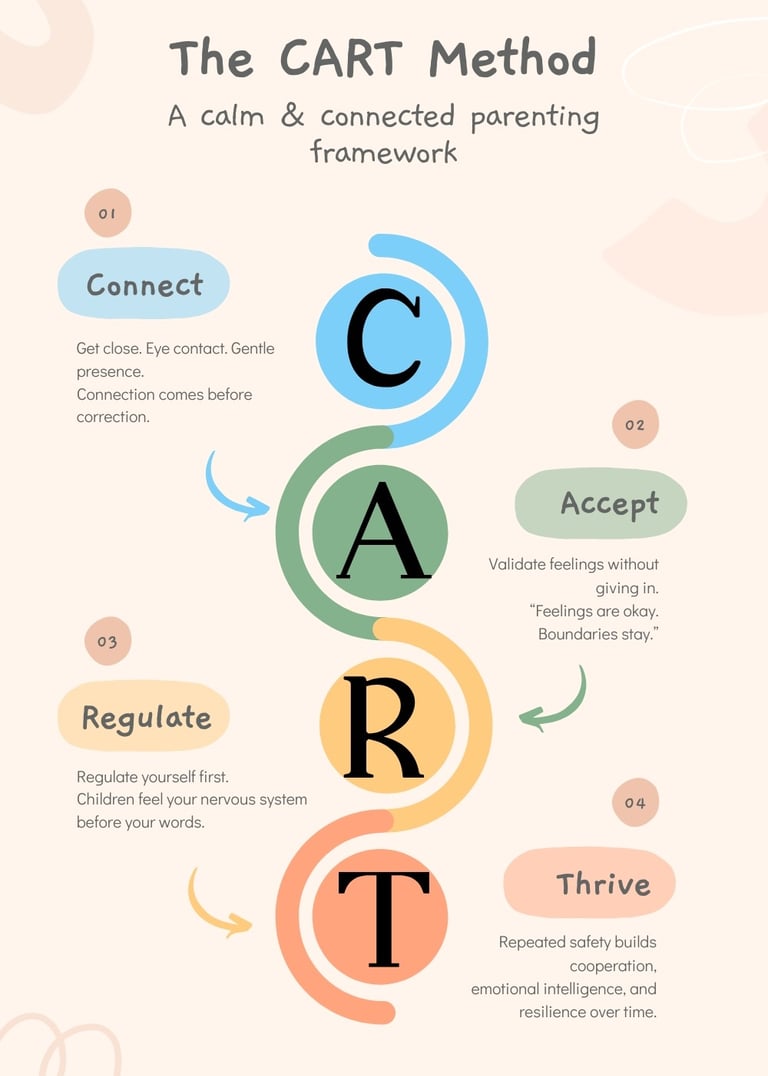
A Parenting Framework for Raising Emotionally Intelligent Toddlers.
Parenting toddlers isn’t about quick fixes or Pinterest hacks, it’s about helping your child handle life’s big feelings with confidence. That’s why I created the CART Method™.
It’s a simple, four-step framework—Connect, Accept, Regulate, Thrive—that helps you stay calm, connected, and confident while guiding your toddler through meltdowns, big emotions, and everyday challenges.
If you’ve ever searched for toddler tantrum help or ways to build emotional intelligence in toddlers, this method is for you.
My Story: From snapping to connecting
Let’s be real: I didn’t come up with CART because I had it all figured out. It was because I hadn't figured it all out.
When my toddler first started having tantrums, I was overwhelmed. Her screams lit up something inside me, I’d feel my chest tighten, my voice rising before I could stop it. And then the guilt. Every time I yelled, she cried harder. Every time I snapped, I saw fear in her eyes. It broke me.
I realized my yelling wasn’t solving anything. If anything, it was scaring the one person who trusted me most. So I started practicing something new. I’d pause. I’d breathe. And on the really hard days? I’d step out of the room to calm my own nerves before coming back to her.
That shift changed everything. I saw her not as a problem to fix, but as a little human having a hard time. She wasn’t giving me a hard time. She was having a hard time. And I was her safe space.
I remembered being yelled at as a kid. I remembered hating it. And I knew I didn’t want to carry that pattern forward.
So now my rule is simple: connect first, correct later. That’s the heart of The CART Method.
Why CART?


Parenting today looks nothing like it did 30 years ago. Back then, “good behavior” usually came from fear, shame, or bribery. Our parents did what they knew, but many of us are working hard to break those cycles.
Still, it’s not easy. When your toddler is lying on the floor because the cup is the wrong color, every cell in your body wants to make it stop. That’s when old habits try to creep in.. yelling, dismissing, or giving in just to quiet the storm.
CART is the tool that stops you from spiraling. It gives you four steps to lean on when your brain is fried, your patience is gone, and you just want peace. Instead of reacting, you respond. Instead of breaking trust, you build it.
The CART Method Breakdown
The CART Method isn’t a quick tip, it’s a mindset you can return to again and again. Whether it’s tantrums at home, boundary-setting at the park, or emotional moments at bedtime, this framework keeps you steady and your child supported.
C: Connect
Connection is the foundation of it all. A child who feels connected feels secure—and secure kids listen, learn, and grow better. Connection doesn’t have to be grand gestures. It’s eye contact. A gentle touch. Squatting down to their level. Saying, “I see you. I’m here.”
Every moment of connection deposits into their emotional “bank account.” So when the hard moments come, you’re not starting from zero.
A: Accept
Accepting doesn’t mean giving in. It means validating feelings while holding boundaries.
When your toddler wails “I hate bedtime!” you don’t have to change bedtime. You can say, “I know you don’t want to stop playing. It’s hard to stop when you’re having fun.” That acknowledgment alone calms their nervous system. They don’t feel dismissed—they feel understood.
Acceptance is also about us as parents. If you grew up in a “don’t cry or I’ll give you something to cry about” household, accepting your child’s feelings feels unnatural. But breaking that cycle is where healing happens—for both of you.
R: Regulate
Regulation is the bridge between chaos and calm. Sometimes it means co-regulating with your child—offering a hug, steady breathing, or simply sitting close until they settle. Sometimes it means regulating yourself first.
I’ve had to walk out of the room, take a few breaths, and come back with a calmer voice. That’s regulation. Kids don’t learn calm from lectures—they learn it by experiencing calm with you.
Over time, your child starts copying those tools. They pause. They breathe. They hug a stuffed animal for comfort. That’s self-regulation being born.
T: Thrive
When connection, acceptance, and regulation work together, children don’t just survive—they thrive. They feel safe to explore, confident to try, and resilient when things don’t go their way.
Thriving doesn’t mean no tantrums. It means tantrums aren’t the end of the world. It means you and your child walk through them together and come out stronger.
CART in real life
Now you might think this method sounds good in theory but what about real life? Here are some everyday examples:
Grocery store meltdown: Connect by getting down to eye level, Accept the disappointment over the candy, Regulate with calm breathing, Thrive as your child eventually learns that feelings are okay but boundaries stand.
Bedtime battles: Connect with a cuddle, Accept the sadness about play ending, Regulate with a calm routine, Thrive with better sleep and less struggle over time.
Toy-sharing conflict: Connect with both kids, Accept their frustration, Regulate by modeling turn-taking, Thrive as they practice empathy and patience.
I know this is easier said than done, and we are running late, exhausted and the toddler tests out limits, we are bound to give in and fall into old patterns, the ones our nervous system knows, the ones we grew up with. But that does not mean it's impossible to break those patterns. One thing I always like to remind myself and other parents I talk to is, "Toddler is not giving us a hard time, they are having one". And self-regulation does not necessarily mean processing our emotions right in the moment. We just need to regulate, handle the situation at hand and can process our emotions later.
Parenting isn’t about never losing it. It’s about choosing connection, again and again, even when it’s hard. CART is here to remind you of that.
Waiting to hear from you!
Listening to your feedback and reading your comments makes me very happy. Contact me if you have any questions, comments or just want to vent out. I will get back to you as soon as I can. Remember that you can also follow me on my social networks or write to my email: bhakti@thecartmethod.com. I am that mom friend you text at 2am.